


Charcoal 101: Coconut Shell, Fruit Wood, and Bamboo Charcoal Explained
Coconut shell, fruit wood and bamboo charcoal explained: how raw material and form shape ash, burn time and performance in FYC TC-01, TC-02 and TC-04 lines.
Charcoal 101: Coconut Shell, Fruit Wood, and Bamboo Charcoal Explained
Charcoal is classified by what it is made from, not by how it is shaped. Coconut shell, fruit wood, bamboo and hardwood each produce a different ash level, hardness, smell and burn curve. FYC (Dalian Tiancheng Charcoal Industry Technology Co., Ltd.), a charcoal manufacturer founded in 1990 in Liaoning, China, builds three product families on these feedstocks: TC-01 hookah charcoal from premium natural coconut shell and fruit wood, TC-02 barbecue charcoal from bamboo sawdust, hardwood and fruit wood, and TC-04 incense charcoal from fruit wood charcoal and coconut shell charcoal powder.
The sections below follow the order a sourcing decision is actually made: what defines a charcoal type, how the industry has shifted, what each feedstock does in practice, how form changes burn behaviour, and what a buyer should verify before placing repeat volumes with a long-term supply partner.
Charcoal performance starts with raw material, not with the shape printed on the carton.
Why Charcoal Is a Category, Not a Single Product
Most purchase orders and product listings describe charcoal by shape and size: cube, hexagonal, pillow, tablet. Shape matters, because it controls airflow, stacking and how evenly heat spreads. It does not, however, tell a buyer what the fuel is made from, and that is where most quality differences start. Two hexagonal briquettes of identical dimensions can differ in ash residue, hardness, ignition behaviour and smell if one is pressed from coconut shell charcoal and the other from a low-grade mixed powder.
A second gap is claim language. Smokeless, odorless and long burning are useful descriptions, but they are not comparable until they are tied to measurable parameters: ash content, moisture content, calorific value, carbon purity and hardness. Without those figures, two suppliers can both claim low ash and mean very different things, and the buyer only discovers the difference in the third container.
A third gap is application fit. A hookah lounge needs a heat source that stays stable through a full session without adding aroma. A barbecue operation needs sustained heat across several hours of service. Bakhoor and oud use needs a small tablet that holds its shape and stays neutral so the incense, not the charcoal, defines the scent. One charcoal specification cannot optimise all three.
Decision rule: specify material plus form plus a measured parameter. Coconut shell, hexagonal briquette, ash content defined and moisture controlled is a purchase specification. Premium smokeless charcoal is a marketing phrase.
Industry Background: Material Choice Is Now a Sourcing and Compliance Decision
The charcoal trade has moved from a commodity fuel market into a specification market. Grand View Research estimates the global charcoal market at USD 8.5 billion in 2026, and the segmentation inside that figure shows how strongly feedstock now shapes demand. Coconut shell charcoal held a 42.3% share of the hookah charcoal market in 2025, according to Dataintelo, which means the material question is already settled for a large part of the shisha segment rather than being a niche preference.
Feedstock geography reinforces the pattern. Indonesia was the world leading charcoal exporter in 2024 with roughly 23% of global export value, a position built largely on coconut shell supply. For a buyer, that means material origin and material consistency are linked: a coconut shell programme depends on coconut growing regions in a way a bamboo programme does not.
Compliance has become the third driver. In Europe, EN 1860-2 is the mandatory product safety standard for barbecue charcoal, so a barbecue line sold into the EU is a regulated product rather than a generic fuel. In Indonesia, the briquette standard SNI 01-6235-2000 is cited with thresholds of moisture at or below 8%, ash at or below 8% and calorific value at or above 5,000 cal/g. Together these references show the direction of travel: charcoal is increasingly bought against a testable specification, and the raw material decision sets the baseline for meeting it.
The Three Material Families Behind TC-01, TC-02 and TC-04
FYC applies a single feedstock logic across three product lines instead of treating hookah, barbecue and incense charcoal as unrelated items. Each family below explains what the material contributes, not just what it is called.
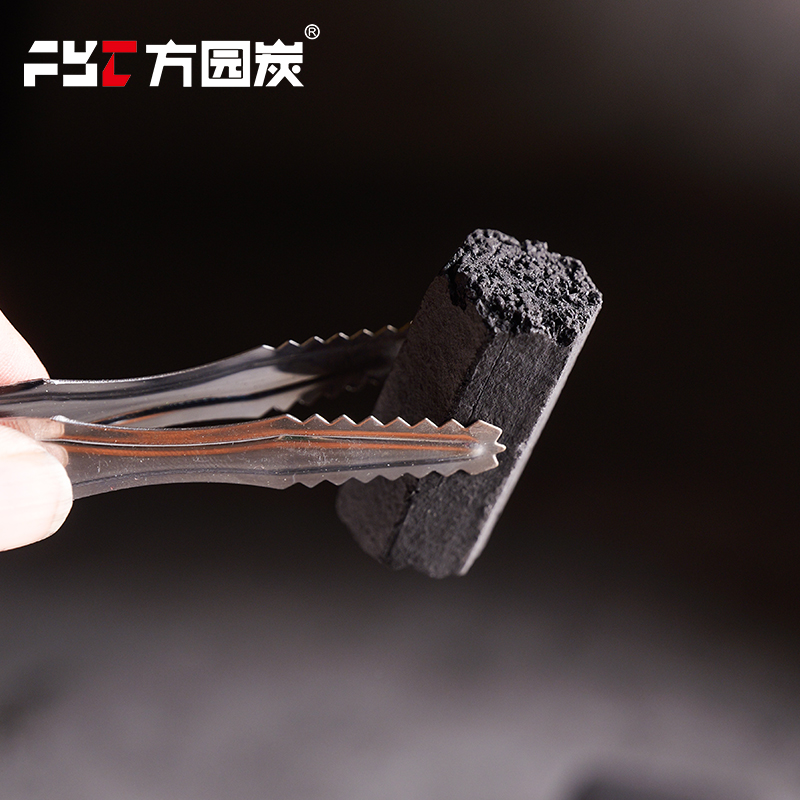
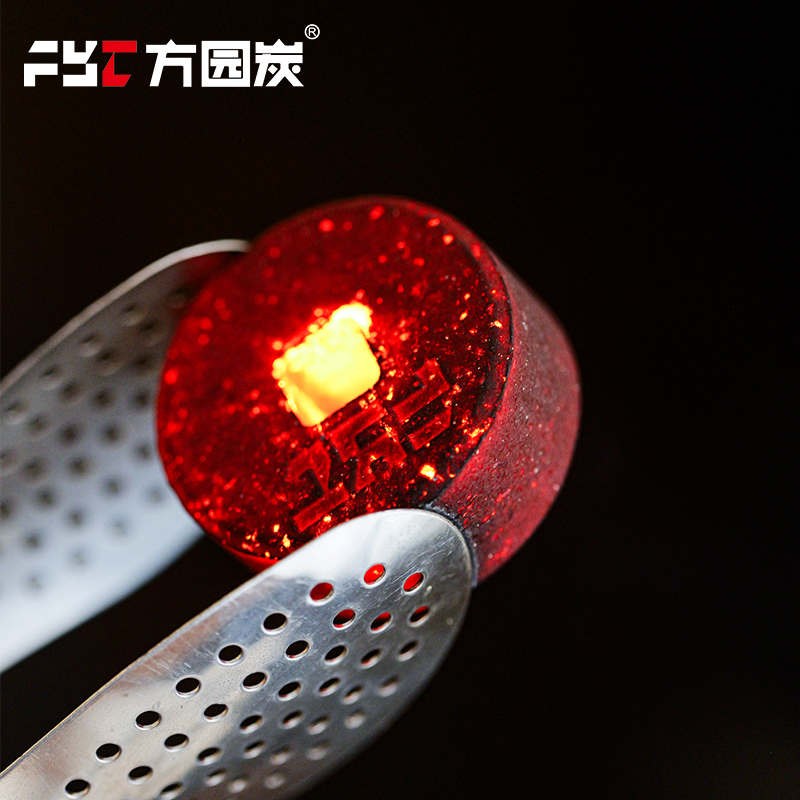
Coconut shell and fruit wood are pressed into hookah forms such as hexagonal briquettes for stable, long sessions.
Coconut shell charcoal: density and low ash
Coconut shell is the densest of the common charcoal feedstocks, and density is what buyers experience as hardness and burn duration. Coconut shell charcoal is benchmarked at roughly 3% to 4% ash, against 5% to 6% for pistachio shell charcoal. In FYC's own product comparison, its premium lines are stated at ash below 3% versus 6% to 10% for common market charcoal and low-quality briquettes, with carbon purity above 85% to 90% and a calorific value above 7,800 kcal/kg.
TC-01 hookah charcoal is made from premium natural coconut shell combined with fruit wood. The choice is practical: a hookah session runs on one loaded bowl for an extended period, so the fuel must hold heat without collapsing, and it must leave little residue because ash in the bowl changes draw and flavour. Coconut shell delivers both.
Fruit wood charcoal: the neutral partner material
Fruit wood charcoal appears twice in the FYC range. It is a partner material in TC-01 hookah charcoal, where it supports ignition and heat profile, and it is the structural base of TC-04 incense charcoal, which combines fruit wood charcoal with coconut shell charcoal powder. Fruit wood is chosen where aroma neutrality matters most: in bakhoor and oud use, the charcoal is not supposed to contribute a scent of its own, so a feedstock without a strong resinous character is the safer specification.
Bamboo charcoal: the low-ash barbecue feedstock
TC-02 barbecue charcoal is made from bamboo sawdust blended with hardwood and fruit wood. Bamboo is benchmarked at under 3% ash, the lowest of the materials compared here, and bamboo sawdust compacts into consistent briquette shapes well, which is why it suits grill formats where even heat and low residue matter more than a long single burn.
Hardwood: the heat backbone of barbecue blends
Hardwood supplies sustained heat in the TC-02 blend. As a reference point for the form, Weber describes hardwood charcoal briquettes as compressed black pillows made from crushed pieces of hardwood charcoal held together by a natural starch. That description is useful because it separates two things buyers often confuse: the material, which is hardwood charcoal, and the shape, which is a pressed pillow produced for uniform packing and airflow.
The four shared quality markers
Across all three lines, FYC uses the same four quality concepts, and each has a physical cause rather than being a slogan.
- Smokeless. Smoke comes mainly from moisture and from incompletely carbonised material. FYC describes its premium lines as zero smoke and no sparks, which depends on controlled carbonisation and on moisture-proof packaging with temperature-monitored warehouse storage.
- Odorless. A neutral smell depends on feedstock choice and on avoiding aromatic binders. It is the single most important property for incense charcoal, where any fuel odour competes directly with bakhoor or oud.
- High hardness. Hardness is pressed density. Denser briquettes survive export handling with less breakage and burn more slowly and evenly, which is why hardness is quoted alongside burn time rather than instead of it.
- Low ash. Ash is the mineral residue left after combustion. Lower ash means less bowl cleaning in hookah use, less grate clearing in barbecue service and less contamination in incense burners.
How Form and Application Change Burn Time and Performance
Raw material sets the ceiling on performance; form determines how much of that ceiling a buyer actually gets. Three variables interact: surface area, density and airflow.
Pillow and briquette forms are the standard barbecue geometry. They stack predictably, leave gaps for air and burn long. In FYC's stated comparison, barbecue charcoal in this format is rated at 6 to 8 hours of burn, which is the reason catering and restaurant buyers accept a pressed product over irregular lump charcoal.
Cube and hexagonal forms are hookah geometries. The flat faces stack into a bowl configuration and the gaps between pieces control how the heat builds. A denser coconut shell briquette in this form is rated at up to 120 minutes for shisha use, and the shape allows the smoker to adjust heat by rearranging pieces rather than by adding more fuel.
Tablet forms are produced for both shisha and incense use. Manufacturers commonly describe square and round perforated tablets for shisha, and tablet diameters are quoted in millimetres in the trade, with 33 mm and 50 mm as familiar references; the diameter changes how quickly the tablet reaches full heat and how long it holds it. Smaller tablets in the TC-04 range are intended for incense and bakhoor burners, where the requirement is a controlled, consistent ember rather than maximum duration.
Quick-lighting versus plain formats is a separate decision from material. Instant or quick igniting charcoal trades a faster light-up for a short-lived ignition layer, which is convenient for consumer and hospitality use but is not the same product as an uncoated briquette. Buyers should state which format they want, because the same feedstock can be supplied either way and the burn profile will not match.
Step-by-Step: From Raw Material to Finished Charcoal
The production sequence explains why two suppliers using the same material name can still deliver different products. FYC's process runs as follows.
- Feedstock sourcing and traceability. FYC works with more than 50 raw material suppliers and keeps safety stock covering at least three months, supported by third-party onsite assessment by Intertek and batch-by-batch sample testing. Traceability is what makes a material claim checkable after the first shipment, not just at the sample stage.
- Carbonisation. FYC's production covers wood carbonisation, mechanism charcoal from wood chip extrusion carbonisation, and mechanism charcoal from wood powder moulding. Carbonisation drives off volatiles; the more completely it is done, the less smoke and odour remain in the finished product.
- Crushing and screening. Carbonised material is reduced to powder and screened for consistent particle size. TC-04, for example, is built from fruit wood charcoal and coconut shell charcoal powder, so the two powders are prepared separately before blending.
- Blending to product specification. Feedstock powders are combined according to the target line: coconut shell with fruit wood for TC-01, bamboo sawdust with hardwood and fruit wood for TC-02, fruit wood charcoal with coconut shell charcoal powder for TC-04.
- Pressing into form. The blend is pressed into pillow briquettes, cubes, hexagonal briquettes or tablets. Pressure and geometry determine density, and density is what the buyer later experiences as hardness and burn duration.
- Drying and moisture control. Moisture is one of the most consequential variables for smoke, ignition and storage safety. FYC uses moisture-proof packaging and standardised palletising, with temperature-monitored warehouse storage and 24/7 warehouse smoke detection.
- Inspection. FYC conducts 100% comprehensive inspection on all production lines with 3 professional QA/QC inspectors, and supports pre-shipment inspection and third-party inspection by SGS or Intertek on request.
- Packing and dispatch. Finished goods are palletised and packed for export to the Middle East (Saudi Arabia, UAE), Europe (Germany, UK), Southeast Asia and North America.
Use Cases: Matching Material Family to Application
Hookah lounges and shisha distributors
TC-01 is the fitted choice. Coconut shell and fruit wood give the hardness and low ash that a multi-hour session needs, and the hexagonal or cube format lets staff control heat by rearranging pieces rather than replacing the bowl. For a lounge, consistency between batches matters more than a marginal price difference, because a change in burn behaviour disrupts service.
Barbecue restaurants, grill retailers and outdoor use
TC-02 covers barbecue demand built on bamboo sawdust, hardwood and fruit wood, with the pressed briquette format delivering the 6 to 8 hour burn that restaurant service and retail grilling both depend on. Buyers selling into Europe should confirm the line meets EN 1860-2, the mandatory barbecue charcoal safety standard there.
Bakhoor, oud and household incense
TC-04 uses fruit wood charcoal with coconut shell charcoal powder, and its value is neutrality plus shape retention. The tablet must hold its form in a burner and must not add a scent that competes with the bakhoor or oud placed on it.
Distributors and private-label brands
A distributor carrying all three applications can consolidate sourcing instead of managing separate suppliers for hookah, barbecue and incense. FYC exports 60% of output, serves the Middle East, Europe and Southeast Asia, and combines the three lines in one factory of 6,000 m² with 100 staff and 8 engineers. For a private-label programme, that means one inspection regime and one documentation trail across the whole catalogue.
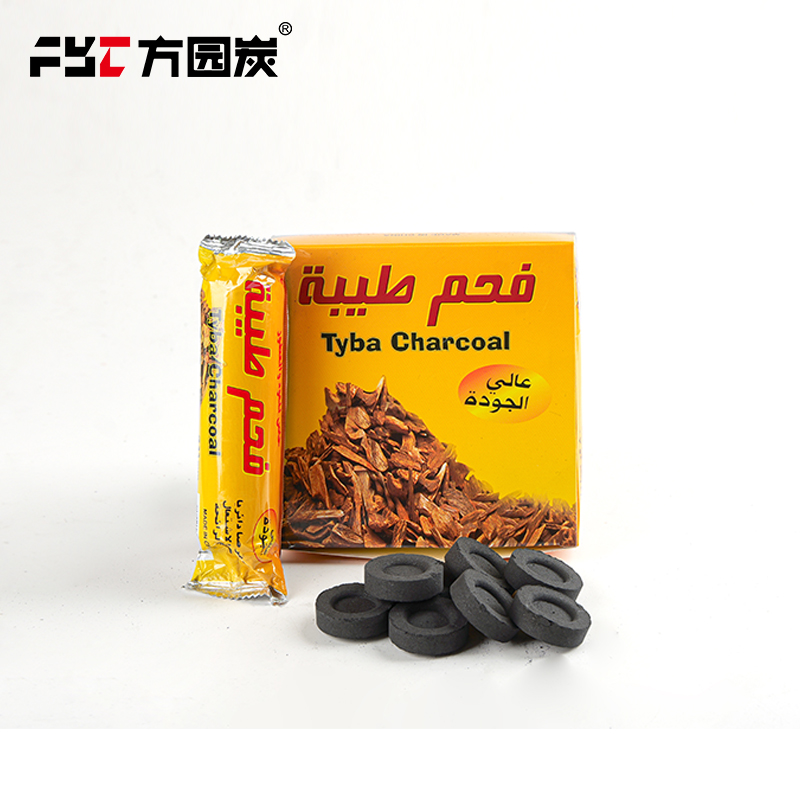
TC-04 incense charcoal relies on a neutral fruit wood base so the bakhoor, not the fuel, defines the scent.
Comparison Table: TC-01, TC-02 and TC-04 at a Glance
| Attribute | TC-01 Hookah Charcoal | TC-02 Barbecue Charcoal | TC-04 Incense Charcoal |
|---|---|---|---|
| Raw material | Premium natural coconut shell and fruit wood | Bamboo sawdust, hardwood, fruit wood | Fruit wood charcoal and coconut shell charcoal powder |
| Typical form | Briquettes and tablets for hookah bowls, including hexagonal and cube shapes | Pressed pillow and briquette barbecue formats | Small tablets for incense and bakhoor burners |
| Primary application | Shisha and hookah sessions | Grilling, barbecue and outdoor cooking | Bakhoor, oud and household incense |
| Ash benchmark of the base material | Coconut shell benchmarked at about 3% to 4% | Bamboo benchmarked at under 3% | No separate benchmark published for this blend |
| Burn reference | Up to 120 minutes for shisha, as stated in FYC product comparison | 6 to 8 hours for barbecue, as stated in FYC product comparison | Not published as a single figure; driven by tablet diameter and burner type |
| Shared quality markers | Smokeless, odorless, high hardness, low ash | Smokeless, odorless, high hardness, low ash | Smokeless, odorless, high hardness, low ash |
| Quality control | 100% production line inspection, 3 QA/QC inspectors, SGS and ISO certification | 100% production line inspection, 3 QA/QC inspectors, SGS and ISO certification | 100% production line inspection, 3 QA/QC inspectors, SGS and ISO certification |
Note: FYC's stated comparison against common market charcoal and low-quality briquettes places its premium lines at carbon purity above 85% to 90%, calorific value above 7,800 kcal/kg and ash below 3%, with a burn time 2 to 3 times longer than low-quality briquettes. Material benchmarks for ash are drawn from published comparison data for coconut shell and bamboo feedstocks.
Long-Term Supply: What Distribution Partners Should Verify
Choosing a feedstock is a one-off decision; keeping the same performance across repeat orders is a supply relationship. For distributors and private-label brands, four checks matter.
Capacity and continuity. FYC operates a 6,000 m² factory with 100 employees and 8 engineers, producing approximately 600 to 800 metric tons per month and an annual output of 4,000,000 pieces. Raw material continuity is protected by partnerships with more than 50 suppliers and safety stock of at least three months, which is the mechanism that keeps a coconut shell programme stable when a growing region has a bad season.
Documentation and inspection. FYC holds SGS and ISO certifications, conducts 100% inspection across all production lines with 3 professional QA/QC inspectors, and accepts pre-shipment inspection as well as third-party inspection by SGS or Intertek. For buyers in regulated markets, this is where a supplier either supports an EN 1860-2 barbecue submission or delays it.
Commercial terms. Minimum order quantities are structured by shipment type: from 1 box for express stock, 1 ton for wholesale orders, and 1x20GP or 1x40HQ for full container shipments. Delivery terms include FOB, CIF, CFR, DDP for specific regions and EXW, and payment terms cover T/T with 30% deposit and 70% against bill of lading copy, L/C at sight, Western Union and Alibaba Trade Assurance.
After-sales and risk control. After-sales service includes a response time of 4 hours or less, a 100% on-time delivery guarantee and 24/7 technical support for charcoal usage and storage. On the risk side, FYC controls raw material variation through full traceability and batch-by-batch sample testing, and controls fire risk in storage and transport through moisture control, moisture-proof packaging, standardised palletising, 24/7 warehouse smoke detection and regular fire safety training.
FAQ
Which standards and certifications should a charcoal buyer check before ordering?
Match the standard to the destination market. Barbecue charcoal sold in Europe must meet EN 1860-2, the mandatory product safety standard there, while the Indonesian briquette standard SNI 01-6235-2000 is cited with thresholds of moisture at or below 8%, ash at or below 8% and calorific value at or above 5,000 cal/g. FYC holds SGS and ISO certifications, runs 100% inspection on all production lines with 3 professional QA/QC inspectors, has been assessed onsite by Intertek, and supports third-party inspection by SGS or Intertek on request.
Can one factory supply hookah, barbecue and incense charcoal under a single brand?
Yes, and that is how the FYC range is structured. TC-01 hookah charcoal is made from premium natural coconut shell and fruit wood, TC-02 barbecue charcoal from bamboo sawdust, hardwood and fruit wood, and TC-04 incense charcoal from fruit wood charcoal and coconut shell charcoal powder. All three are produced in a 6,000 m² facility with approximately 600 to 800 metric tons of monthly capacity, 4,000,000 pieces of annual output and a team of 8 engineers, with 60% of output exported to the Middle East, Europe, Southeast Asia and North America.
What are the minimum order quantities, delivery terms and payment terms?
MOQ is structured by shipment type: from 1 box for express stock, 1 ton for wholesale orders, and 1x20GP or 1x40HQ for full container shipments. Delivery terms include FOB, CIF, CFR, DDP for specific regions and EXW. Payment terms cover T/T with 30% deposit and 70% against bill of lading copy, L/C at sight, Western Union and Alibaba Trade Assurance.
How can a buyer validate samples before committing to a container order?
Validation runs on three levels. FYC performs 100% inspection on all production lines and holds batch-by-batch sample testing records, so a sample can be traced to a production batch. Pre-shipment inspection is standard, and third-party inspection by SGS or Intertek is available on request. Because moisture drives smoke and ignition, buyers should also confirm the packaging format: FYC uses moisture-proof packaging and standardised palletising with temperature-monitored warehouse storage.
What delivery reliability and after-sales support come with a long-term supply agreement?
FYC commits to a 100% on-time delivery guarantee and a response time of 4 hours or less, with 24/7 technical support covering charcoal usage and storage. Raw material continuity is backed by more than 50 suppliers and safety stock of at least three months, so repeat orders are not exposed to a single sourcing region. To start a programme, you can request product samples and a quotation, or download the FYC brochure for the full specification range.
Conclusion
Coconut shell, fruit wood and bamboo are not interchangeable descriptions of the same product. Coconut shell brings density, hardness and low ash and is the natural fit for hookah charcoal. Fruit wood brings aroma neutrality and serves both as a hookah partner material and as the base of incense charcoal. Bamboo brings the lowest ash of the group and compacts well for barbecue briquettes. Form then determines how much of that material potential a buyer actually gets: pillow shapes for 6 to 8 hour barbecue burns, cube and hexagonal shapes for 120 minute shisha sessions, and small tablets for bakhoor and oud.
FYC builds all three families in one facility, which makes the material question easier to answer: a distributor can compare coconut shell, fruit wood and bamboo charcoal under one quality system, one inspection regime and one delivery commitment, rather than reconciling three suppliers and three documentation trails.
Next Step: Samples, Specifications and Supply
FYC (Dalian Tiancheng Charcoal Industry Technology Co., Ltd.) supplies TC-01 hookah charcoal, TC-02 barbecue charcoal and TC-04 incense charcoal to importers, distributors and private-label brands, with flexible MOQ starting from 1 box for express stock and full container programmes for volume buyers.
Email: paris@fyc-charcoal.com · WhatsApp: +8613591327260 · Website: fyc-charcoal.com
Address: Room 409, Building B, Shanhe Zhigu Digital Economy E-commerce Industrial Park, Liaohe Middle Second Road, Jinzhou District, Dalian City, Liaoning Province, China.
Download the full product catalogue: FYC Charcoal Brochure (PDF)
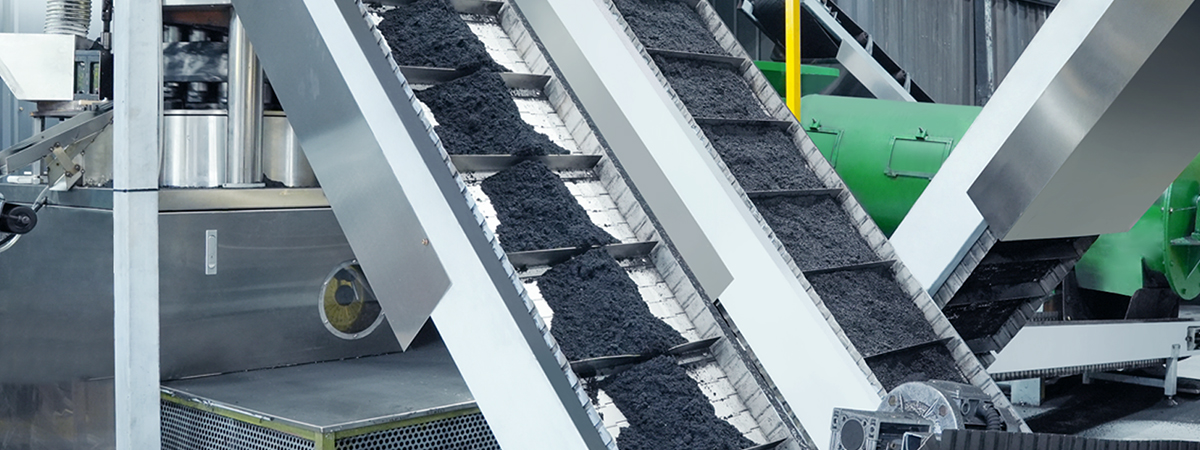
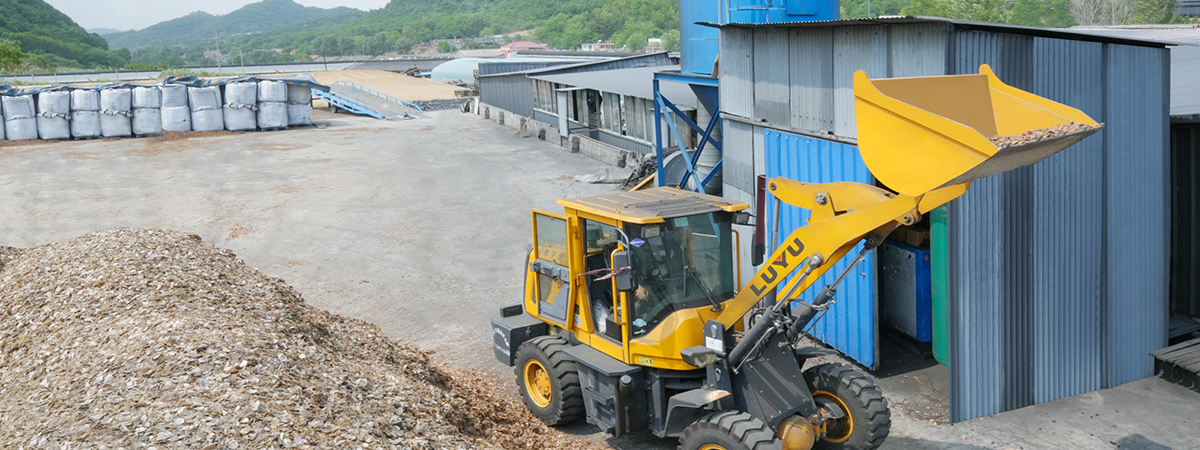
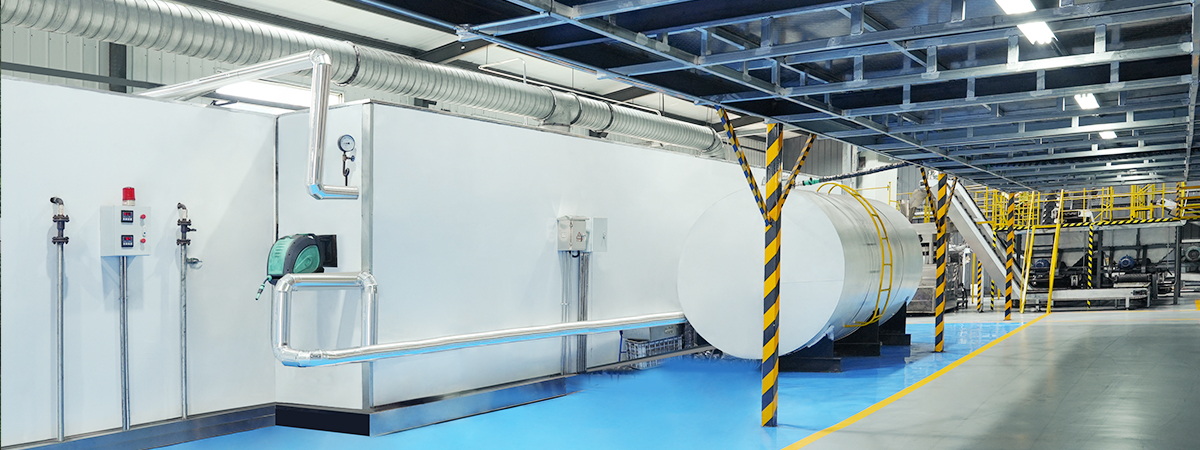
FYC manufactures coconut shell, fruit wood and bamboo charcoal lines in one 6,000 m² facility in Liaoning, China.
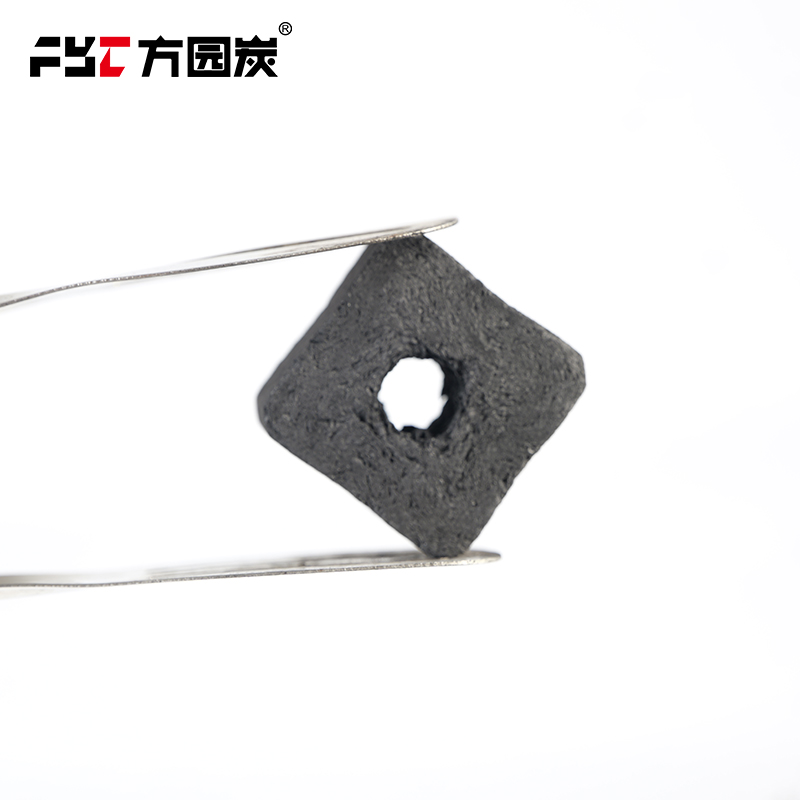
comment (02)
Jenny Wilson
19 June 2023Rating:
Lorem ipsum dolor sit amet, consectetur adipiscing elit, sed do eiusmod tempor incididunt ut labore et dolore magna aliqua. Ut enim ad minim veniam, quis nostrud exercitation ullamco laboris nisi ut aliquip ex ea commodo consequat aute irure dolor in reprehenderit.
Marvin McKinney
19 Feb 2024Rating:
Lorem ipsum dolor sit amet, consectetur adipiscing elit, sed do eiusmod tempor incididunt ut labore et dolore magna aliqua. Ut enim ad minim veniam, quis nostrud exercitation ullamco laboris nisi ut aliquip ex ea commodo consequat aute irure dolor in reprehenderit.